The Premise
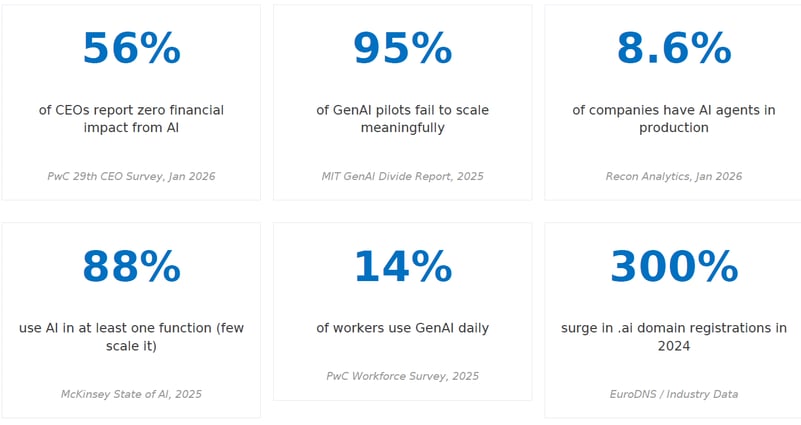
If you want to double your company's valuation overnight, just add '.ai' to your domain name and mention 'large language models' in your next earnings call. In 2024, .ai domain registrations surged 300% with 20,000 new domains monthly. An interior design firm in Singapore rebranded as an AI company, watched its stock climb 1,700% on NASDAQ, and was flagged by short sellers as a pump-and-dump. The SEC has started fining companies for 'AI washing,' penalizing firms like Delphia and Global Predictions for claiming their AI made investment decisions when it was really basic data analysis wearing a very expensive hat.
According to PwC's 29th Global CEO Survey (January 2026, 4,454 CEOs, 95 countries), 56% of chief executives report zero financial impact from AI. Only 12% have achieved both lower costs and higher revenue. MIT found that 95% of generative AI pilots fail. Gartner officially placed AI in its 'Trough of Disillusionment,' the corporate research equivalent of your mother saying 'I told you so.' Most
organizations are stuck in 'pilot purgatory': AI used enough to feel like progress, never deeply enough to create measurable results.
The Market Reality
McKinsey confirms 88% of organizations use AI in at least one function, but fewer than 40% have scaled beyond pilot. Recon Analytics found only 8.6% have AI agents in production. Lucidworks found only 6% have fully implemented agentic AI. PwC's Workforce Survey: only 14% of workers use generative AI daily.
In practice? Your marketing team uses ChatGPT to draft posts (and rewrites them because the AI calls everything 'a game-changer'). Executives summarize emails they should have just read. IT is 'vibe coding' with Copilot, ungoverned. Someone bought an 'AI-powered' analytics tool that is actually a SQL query with a chatbot wrapper. And the CTO approved an 'AI Center of Excellence' consisting of three people, a Slack channel, and a doc titled 'AI Strategy v7_FINAL_FINAL(2).docx
PwC's analysis is blunt: companies treating AI as isolated tactical projects rarely deliver measurable value. The 12% seeing returns deploy AI extensively, aligned with strategy, not running experiments in a corner hoping for magic.

What Real AI Engineering Looks Like
At Aubrant Digital, our professionals have been building complex AI solutions since before LLMs became a household topic and the world discovered ChatGPT (or as many early adopters confidently typed, 'ChatGBT'). We built recommendation engines, NLP pipelines, and ML-powered systems when 'artificial intelligence' still sounded like science fiction to most boardrooms. We do not sell strategy decks about AI. We build AI systems that run in production and generate measurable returns.
Agentic AI for a 100K-User Commercial B2B SaaS Platform
Aubrant engineered a production-grade AI orchestration layer using LangChain/LangGraph with Python, building structured workflows that let LLMs reason over platform capabilities. A custom MCP server exposes product features as machine-consumable tools. The resulting AI Copilot navigates, queries, and operates functionality for 100,000+ users. The architecture is LLM-agnostic and
future-proof. This is the engineering that .ai domain names imply but rarely deliver.
Fully Agentic Business Loan Underwriting
Aubrant is building a fully agentic loan application and underwriting process on Azure for a major business loan funder, making them the first of their kind. The multi-agent architecture automates intake, document processing, risk assessment, and decisioning. The result: unprecedented speed (because waiting three weeks for a loan decision feels about as enjoyable as debugging COBOL on a Friday evening) and a 40% cost advantage. That is not 'we put AI in our pitch deck' value. That is 'we restructured unit economics.'
Published Use Cases:
Unified Digital Foundation: Powering a Global Live Sports Platform
Event-driven architecture, AI, and platform services integrated into one cohesive foundation powering live streaming, fan engagement, and operations at global scale.
3.6M Lines of Truth: AI-Powered Due Diligence for a Life Science Business
The Aubrant Workbench analyzed 3.6M lines across 204 projects, validated against 1,966 production traces, identified 21 pain
points, and quantified ~43,000 developer-hours of savings. Modernization compressed from years to 18-24 months.
$3M Saved. Agentic AI Reinvented Enterprise Regression Testing
500+ manual smoke tests replaced by autonomous AI agents on Temporal.io, LangGraph, and Playwright. Delivered in 90 days: 80% faster cycles, 100% automated evidence, zero manual tickets.
Beyond the Team: The Aubrant Workbench
Beyond the global team in our Data and AI Studio, what makes Aubrant unlike any other firm is the Aubrant Workbench: a proprietary, AI-accelerated software engineering platform built for regulated enterprises that need to modernize complex systems without sacrificing governance, traceability, or compliance. It addresses a fundamental gap: while AI coding tools have demonstrated impressive code generation capabilities, they have not mastered software engineering, the disciplined, end-to-end
process of translating business requirements into production-ready, auditable, maintainable systems. The Workbench closes that gap by combining enterprise AI with deterministic, pre-built components and enforceable governance guardrails across the full software lifecycle.
The platform is built on two pillars. Aubrant Intelligent Engineering (AIE) is an internal, Azure-hosted multi-agent AI pipeline that automates eight phases of software engineering: from business and technology context generation through governance enforcement, requirements engineering, architecture design, code generation, quality assurance, and CI/CD composition. Each phase is independently orchestrated through a contract-bound agent model with formal input/output schemas, versioned interfaces, and full traceability. Aubrant Reusable Modules (ARM) is a catalog of productized, deployable building blocks covering UI, integration, orchestration, data, AI, and infrastructure capabilities, shipped as sealed OCI images into client environments with controlled extensibility through configuration overlays, plugin endpoints, and event hooks. Together, AIE and ARM enable engineering teams to deliver production-ready software up to 70% faster while maintaining the audit trails and deterministic controls that regulated industries demand.
What distinguishes Workbench from AI coding assistants and low-code platforms is its emphasis on architectural integrity and compliance as first-class concerns. Every artifact produced by AIE carries evidence-backed traceability: cited fact stores, design decision records, and human-in-the-loop approval gates, ensuring outputs withstand regulatory scrutiny under SOC 2, HIPAA, PCI DSS, and FedRAMP. ARM modules follow a three-tier IP protection model (sealed core runtime, open extension SDKs, and contract-first published APIs) giving clients full operational control without vendor lock-in. The result is a platform that treats compliance not as a gate at the end of the pipeline, but as a continuous, enforceable property woven into every phase of delivery. This is the engine behind over 500 successfully completed projects and 90%+ client retention.
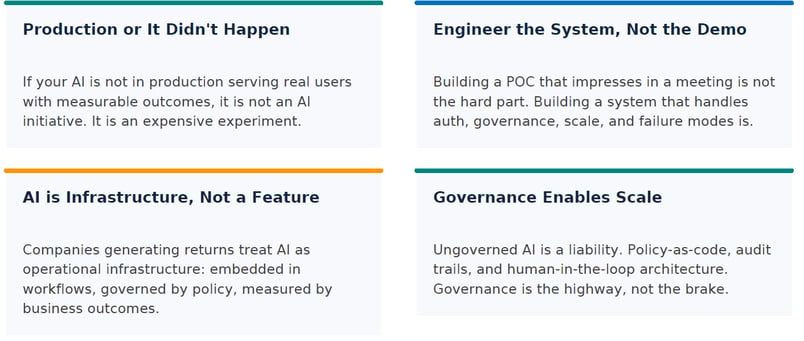
Key Principles
The Takeaway
Sources
• PwC, 29th Global CEO Survey, January 2026. 4,454 CEOs, 95 countries.
• MIT Technology Review, The GenAI Divide Report, August 2025.
• McKinsey & Company, The State of AI in 2025.
• Gartner, Hype Cycle for AI, 2025. 'Trough of Disillusionment.'
• Recon Analytics, Enterprise AI Agent Survey (120K+ respondents, 2025-2026).
• Lucidworks, 2025 AI Benchmark Study (1,600+ AI leaders).
• EuroDNS / Accio Research. .ai domain registrations, 2024.
• SEC Enforcement Actions, March 2024. AI washing penalties.